Penetration Testing in 2024: OWASP Methodologies and Zero Trust
A complete guide to the most advanced penetration testing techniques, OWASP Top 10 framework implementation, and how to integrate these methodologies with Zero Trust architectures to build robust, modern security systems.
Table of Contents
- Introduction to Modern Penetration Testing
- OWASP Top 10 2024: New Vulnerabilities
- Advanced Testing Methodologies
- Essential Tools for 2024
- Integration with Zero Trust Architecture
- Practical Cases and Real Scenarios
- Automation and CI/CD Security
- Conclusions and Future
Introduction to Modern Penetration Testing
The cybersecurity landscape has evolved dramatically in 2024. Organizations face increasingly sophisticated threats, from AI-powered attacks to attack vectors in cloud-native infrastructures. In this context, penetration testing has become a critical discipline that goes far beyond traditional testing.
💡 The Evolution of Pentesting: In 2024, penetration testing integrates traditional methodologies with modern approaches like Zero Trust, DevSecOps, and automated testing in CI/CD pipelines.
Modern organizations need a holistic approach that combines:
- Continuous Testing: Integration into development pipelines
- Automation: Automated testing and scheduled scanning
- Cloud-Native Security: Testing specific to distributed architectures
- Zero Trust Validation: Verification of zero trust policies
- AI-Powered Analysis: Use of machine learning for anomaly detection
OWASP Top 10 2024: New Vulnerabilities
The OWASP Top 10 2024 reflects the evolution of the threat landscape, incorporating new categories that mirror the reality of modern applications:
OWASP Top 10 2024 - Vulnerability Distribution

Critical Vulnerabilities in 2024
⚠️ Security Alert: Vulnerabilities related to AI/ML and cloud infrastructures have increased by 300% compared to 2023.
1. Broken Access Control
Remains the #1 vulnerability, but now includes specific flaws in:
- Microservices and distributed APIs
- Multi-factor authentication (MFA) systems
- Poorly implemented Zero Trust policies
- JWT tokens and OAuth 2.0/OpenID Connect
// Example of secure access control implementation
const authMiddleware = async (req, res, next) => {
  try {
    const token = req.headers.authorization?.split(' ')[1];
    const decoded = jwt.verify(token, process.env.JWT_SECRET);

    // Additional Zero Trust verification
    const userPermissions = await checkUserPermissions(decoded.userId);
    const resourceAccess = await validateResourceAccess(
      decoded.userId,
      req.path,
      req.method
    );

    if (!resourceAccess.allowed) {
      return res.status(403).json({
        error: 'Access denied - Zero Trust policy violation'
      });
    }

    req.user = { ...decoded, permissions: userPermissions };
    next();
  } catch (error) {
    res.status(401).json({ error: 'Authentication failed' });
  }
};
2. AI/ML Security Vulnerabilities (New Category)
For the first time, OWASP includes vulnerabilities specific to AI systems:
- Model Poisoning and Data Poisoning
- Adversarial Attacks on ML models
- Prompt Injection in LLMs
- Model Stealing and Reverse Engineering
🧠 AI Security Testing: Use tools like IBM Adversarial Robustness Toolbox (ART) and Microsoft Counterfit to test the robustness of ML models.
Advanced Testing Methodologies
Traditional methodologies such as OWASP Testing Guide, PTES, and NIST have evolved to incorporate new testing paradigms.
Hybrid Methodology 2024
We combine multiple frameworks to create a comprehensive approach:
-
Pre-Engagement
- Threat Modeling with STRIDE/PASTA
- Automated Asset Discovery
- Zero Trust Architecture Review
-
Intelligence Gathering
- Automated OSINT with AI
- Social Engineering reconnaissance
- Cloud infrastructure enumeration
-
Vulnerability Assessment
- Automated scanning + manual validation
- Container & Kubernetes security testing
- API security assessment
-
Exploitation
- Controlled exploitation with minimal impact
- Lateral movement simulation
- Privilege escalation chains
-
Post-Exploitation
- Data exfiltration simulation
- Persistence mechanisms
- Impact assessment
✅ Best Practice: Implement a "Purple Team" approach where red team and blue team collaborate in real time to improve defenses.
Essential Tools for 2024
The modern penetration testing toolkit has evolved significantly. Here are the indispensable tools for 2024:
Kali Linux 2024.1
The leading distribution with over 600 pre-installed tools. Includes new tools for cloud security and AI/ML testing.
Tags: OS Base · All-in-One · Free
Burp Suite Pro
The most complete platform for web application security testing. Extensions marketplace with over 400 plugins.
Tags: Web Apps · APIs · Premium
Metasploit Framework
Exploitation framework with over 3000 verified exploits. New modules for cloud and container security.
Tags: Exploitation · Post-Exploit · Community
Nessus Professional
Vulnerability scanner with complete coverage. Integrated AI for false positive reduction.
Tags: Scanning · Compliance · Enterprise
Nuclei
Fast vulnerability scanner based on YAML templates. Over 8000 community templates.
Tags: Fast Scanning · Templates · Open Source
Docker Security Tools
Suite of tools for container security: Trivy, Clair, Docker Bench Security.
Tags: Containers · DevSecOps · CI/CD
Emerging Tools in 2024
- Semgrep: Static analysis with customizable rules
- GitLeaks: Secret detection in repositories
- Kubescape: Kubernetes security compliance
- Checkov: Infrastructure-as-Code security scanning
- OWASP ZAP: Automated web application security testing
# Example of automated reconnaissance script
#!/bin/bash

# Subdomain enumeration
subfinder -d target.com -silent | tee subdomains.txt
assetfinder target.com | tee -a subdomains.txt

# Port scanning with nmap
nmap -sS -sV -p- -T4 -iL subdomains.txt -oN portscan.txt

# Web tech detection
for subdomain in $(cat subdomains.txt); do
    whatweb $subdomain >> webtech.txt
done

# Vulnerability scanning with nuclei
nuclei -l subdomains.txt -t vulnerabilities/ -o nuclei-results.txt

echo "Reconnaissance complete. Check the output files."
Integration with Zero Trust Architecture
Zero Trust is not just a security concept — it's a paradigm that requires a specific testing methodology. In 2024, penetration testing must validate every component of the Zero Trust architecture.
Zero Trust Testing Principles
"Never trust, always verify" — but how do we verify that the verification works correctly?
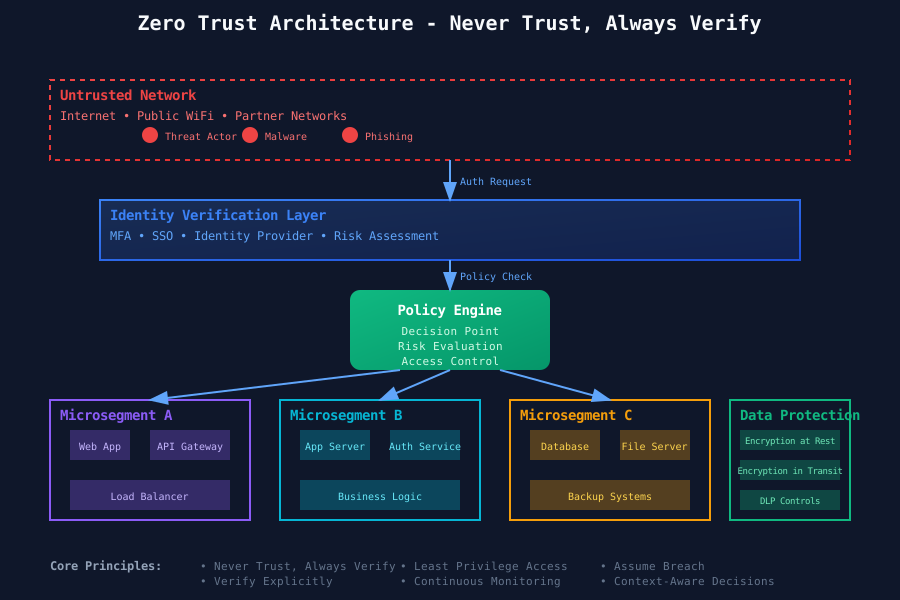
Zero Trust testing focuses on validating:
-
Identity Verification
- Multi-factor authentication bypass attempts
- Identity provider (IdP) vulnerabilities
- Token manipulation and session hijacking
-
Device Trust
- Device registration process security
- Certificate-based authentication
- Mobile device management (MDM) bypass
-
Network Segmentation
- Microsegmentation validation
- Software-defined perimeter (SDP) testing
- Network policy enforcement
-
Application Security
- API gateway security
- Service mesh communication
- Container-to-container communication
-
Data Protection
- Encryption in transit and at rest
- Data loss prevention (DLP) controls
- Rights management systems
🔒 Zero Trust Testing Framework: Develop specific test cases for each policy engine and decision point in your Zero Trust architecture.
Testing Methodology for Zero Trust
# Zero Trust Policy Validation Script
import requests
import json

class ZeroTrustTester:
    def __init__(self, policy_engine_url, auth_token):
        self.base_url = policy_engine_url
        self.headers = {'Authorization': f'Bearer {auth_token}'}

    def test_policy_enforcement(self, user_id, resource, action):
        """Test if Zero Trust policies are correctly enforced"""
        payload = {
            'subject': user_id,
            'resource': resource,
            'action': action,
            'context': {
                'time': '2024-01-26T10:00:00Z',
                'location': 'unknown',
                'device_trust': 'untrusted'
            }
        }

        response = requests.post(
            f'{self.base_url}/authorize',
            headers=self.headers,
            json=payload
        )

        return response.status_code == 403  # Should deny untrusted access

    def test_lateral_movement_prevention(self):
        """Simulate lateral movement attempts"""
        test_cases = [
            {'from': 'web_tier', 'to': 'database_tier', 'expected': False},
            {'from': 'app_tier', 'to': 'database_tier', 'expected': True},
        ]

        results = []
        for case in test_cases:
            allowed = self.check_network_policy(case['from'], case['to'])
            results.append({
                'test': f"{case['from']} -> {case['to']}",
                'expected': case['expected'],
                'actual': allowed,
                'status': 'PASS' if allowed == case['expected'] else 'FAIL'
            })

        return results

# Usage example
tester = ZeroTrustTester('https://policy-engine.company.com', 'your-token')
results = tester.test_lateral_movement_prevention()
print(json.dumps(results, indent=2))
Practical Cases and Real Scenarios
Let's look at some real penetration testing scenarios I've encountered in organizations during 2024:
Case 1: Cloud-Native Application Security
Context: Fintech startup with serverless architecture on AWS, using Lambda, API Gateway, and DynamoDB.
Vulnerabilities found:
- Excessively permissive IAM roles in Lambda functions
- API Gateway without appropriate rate limiting
- Hardcoded secrets in environment variables
- DynamoDB tables without encryption at rest
☁️ Cloud Security Issue: 67% of organizations have insecure configurations in their cloud deployments due to lack of expertise.
Case 2: Kubernetes Cluster Compromise
Context: E-commerce company with microservices on Kubernetes, using Istio service mesh.
Attack Vector:
- Exposed Kubernetes API server without authentication
- Container escape via privileged pod
- Lateral movement through service accounts
- Data exfiltration from persistent volumes
# Kubernetes Security Assessment Script
#!/bin/bash

echo "=== Kubernetes Security Assessment ==="

# Check for privileged containers
echo "Checking for privileged containers..."
kubectl get pods --all-namespaces -o jsonpath='{range .items[*]}{.metadata.name}{"\t"}{.spec.securityContext.privileged}{"\n"}{end}' | grep true

# Check for containers running as root
echo "Checking for root containers..."
kubectl get pods --all-namespaces -o jsonpath='{range .items[*]}{.metadata.name}{"\t"}{.spec.containers[*].securityContext.runAsUser}{"\n"}{end}' | grep -E "(^[^\t]*\t0$|^[^\t]*\t$)"

# Check for network policies
echo "Checking network policies..."
kubectl get networkpolicies --all-namespaces

# Check for pod security policies
echo "Checking pod security policies..."
kubectl get psp

# Check for RBAC configurations
echo "Checking RBAC..."
kubectl get clusterrolebindings -o wide
Case 3: AI/ML Model Security Testing
Context: Healthcare company with ML models for medical diagnosis.
Testing Approach:
- Adversarial examples generation
- Model inversion attacks
- Training data extraction
- Model stealing via API queries
# AI/ML Security Testing Example
import numpy as np
from sklearn.ensemble import RandomForestClassifier
from art.attacks.evasion import FastGradientMethod
from art.estimators.classification import SklearnClassifier

def test_model_robustness(model, test_data, test_labels):
    """Test ML model against adversarial attacks"""

    # Wrap model for ART
    classifier = SklearnClassifier(model=model)

    # Generate adversarial examples
    attack = FastGradientMethod(estimator=classifier, eps=0.1)
    adversarial_examples = attack.generate(x=test_data)

    # Test original vs adversarial accuracy
    original_accuracy = model.score(test_data, test_labels)
    adversarial_accuracy = model.score(adversarial_examples, test_labels)

    robustness_score = adversarial_accuracy / original_accuracy

    return {
        'original_accuracy': original_accuracy,
        'adversarial_accuracy': adversarial_accuracy,
        'robustness_score': robustness_score,
        'vulnerable': robustness_score < 0.8
    }

# Usage
model = RandomForestClassifier()
# ... train model ...
results = test_model_robustness(model, X_test, y_test)
print(f"Model robustness: {results['robustness_score']:.2f}")
Automation and CI/CD Security
Integrating security testing into CI/CD pipelines is crucial in 2024. The concept of "Shift Left Security" requires intelligent automation that doesn't slow down development.
Automated Security Testing Pipeline
A modern pipeline must include multiple testing stages:
-
Pre-Commit Hooks
- Secret scanning with GitLeaks
- SAST with Semgrep
- Dependency vulnerability checking
-
Build Stage
- Container image scanning with Trivy
- Infrastructure-as-Code scanning with Checkov
- License compliance checking
-
Staging Deployment
- DAST with OWASP ZAP
- API security testing
- Automated network penetration testing
-
Production Monitoring
- Runtime security monitoring
- Threat detection with SIEM integration
- Continuous compliance validation
# GitHub Actions Security Pipeline
name: Security Testing Pipeline

on:
  push:
    branches: [ main, develop ]
  pull_request:
    branches: [ main ]

jobs:
  security-scan:
    runs-on: ubuntu-latest

    steps:
    - uses: actions/checkout@v3

    # Secret Scanning
    - name: Run GitLeaks
      uses: zricethezav/gitleaks-action@master

    # SAST Scanning
    - name: Semgrep Scan
      uses: returntocorp/semgrep-action@v1
      with:
        config: >-
          p/security-audit
          p/secrets
          p/owasp-top-ten

    # Dependency Scanning
    - name: Run Snyk to check for vulnerabilities
      uses: snyk/actions/node@master
      env:
        SNYK_TOKEN: ${{ secrets.SNYK_TOKEN }}

    # Container Scanning
    - name: Build Docker image
      run: docker build -t myapp:latest .

    - name: Scan Docker image with Trivy
      uses: aquasecurity/trivy-action@master
      with:
        image-ref: 'myapp:latest'
        format: 'sarif'
        output: 'trivy-results.sarif'

    # DAST Scanning
    - name: ZAP Baseline Scan
      uses: zaproxy/action-baseline@v0.7.0
      with:
        target: 'http://localhost:3000'
        rules_file_name: '.zap/rules.tsv'

    # Upload results
    - name: Upload Security Results
      uses: github/codeql-action/upload-sarif@v2
      with:
        sarif_file: 'trivy-results.sarif'
Automated Reporting and Metrics
It's crucial to have metrics that demonstrate the value of the security testing program:
- Mean Time to Detection (MTTD) of vulnerabilities
- Mean Time to Resolution (MTTR) of critical issues
- Security Debt Tracking - pending vulnerabilities
- Coverage Metrics - % of code/infrastructure tested
- False Positive Rate of automated tools
📊 Security Metrics Dashboard: Use tools like Grafana with Prometheus to create real-time security metrics dashboards.
Conclusions and the Future of Penetration Testing
Penetration testing in 2024 has evolved toward a more integrated, automated, and continuous approach. Organizations that adopt these modern methodologies will have a significant advantage in their security posture.
Key Trends for 2024-2025
- AI-Powered Testing: Machine learning for test case optimization
- Quantum-Safe Cryptography Testing: Preparing for post-quantum threats
- IoT/Edge Security Testing: Specific methodologies for edge devices
- Supply Chain Security: Testing dependencies and third-party components
- Privacy-by-Design Testing: Validation of GDPR/CCPA compliance
Final Recommendations
- Adopt a Purple Team approach - Continuous collaboration between offense and defense
- Implement continuous testing - Integrate security testing into all SDLC stages
- Invest in intelligent automation - Reduce manual effort without losing quality
- Stay up to date - Technology evolves rapidly; your security testing must evolve too
- Measure and improve - Use metrics to demonstrate value and optimize processes
"The future of penetration testing isn't about running more tests — it's about running smarter, more effective tests."
🚀 Next Steps: Start by implementing a SAST tool in your pipeline, then gradually expand toward DAST and automated testing.
📚 Related Articles
DevSecOps: Integrating Security into the Development Lifecycle
Practical strategies for implementing DevSecOps from the first commit, security testing automation, and building secure CI/CD pipelines.
Application Security: Secure Coding Practices
Best practices for secure web application development, prevention of common vulnerabilities, and implementation of security controls.
Threat Detection with AI: Machine Learning for Cybersecurity
Implementation of machine learning algorithms for automatic threat detection and anomalous behavior analysis.